garden fork
The Curious Incident of the Dog in the Night-TimeThe garden fork is both the instrument used to kill Wellington and the material clue that turns Christopher’s grief and uncertainty into an investigation. Its appearances first establish the violence, then invite a plausible but incomplete deduction about Mrs. Shears and her former husband, before Father’s confession resolves the question of who used it.
Discovery and Immediate Significance
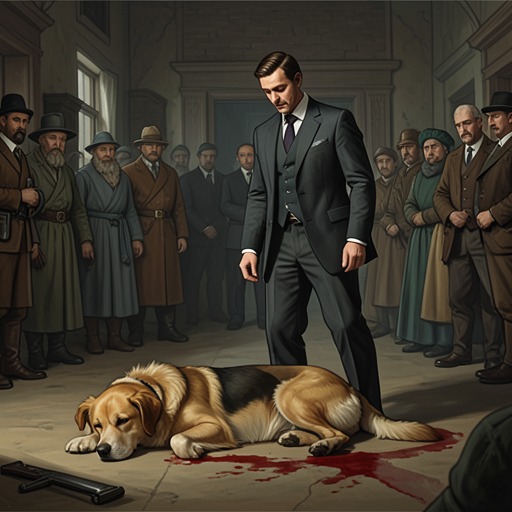
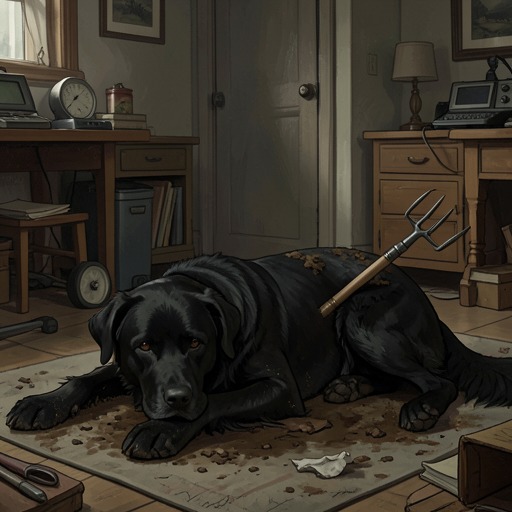
At seven minutes after midnight, Christopher finds Wellington dead on the lawn outside Mrs. Shears’s house, with a garden fork embedded in him. The fork has gone through the dog and into the ground, and Christopher reasons that it was probably the cause of death because he can see no other wounds; he nevertheless acknowledges that he cannot be certain. The object makes the death look less like an unexplained loss and more like a deliberate act, while leaving the killer unidentified.
Christopher goes through the gate, kneels beside Wellington, and touches him, finding that he is still warm. He then pulls out the fork and lifts the dog into his arms. That action removes the visible weapon from the scene, but does not end its importance: the fork becomes the first tangible object around which he can organize questions about the killing.
A Clue in the Investigation
When Christopher later investigates, he finds Mrs. Shears’s shed locked and cannot enter. Looking through its side window, he sees a fork that appears exactly like the one that had been in Wellington. It has been cleaned and lies on a bench beside a spade, a rake, and long-handled clippers, all with matching green plastic handles. The resemblance and the shared handles lead him to infer that the fork belongs to Mrs. Shears.
The discovery does not prove who wielded it. Christopher considers whether Mrs. Shears killed Wellington, but her earlier arrival, shouting at him about what he had done to her dog, makes that explanation seem unlikely to him. He reasons instead that the killer may have used her fork and would either have had access to the locked shed, encountered the tool outside, or benefited from its being left unlocked. The fork therefore supplies a concrete lead while also defining what the investigation cannot yet establish: ownership is not the same as guilt.
From the Tool to a Suspect
Christopher’s reasoning moves from the weapon to possible motives. He considers hatred of Wellington, madness, and a desire to upset Mrs. Shears. Since he knows no one who hated the dog or whom he considers mad, those possibilities point toward a stranger; the third leads him to Mr. Shears, whom he knows disliked Mrs. Shears and who had known Wellington. Christopher makes Mr. Shears his prime suspect, a conclusion shaped by the fork’s association with Mrs. Shears’s home as well as by his account of the relationships around the dog.
Christopher later tells Father that he thinks Mr. Shears probably killed Wellington in order to make Mrs. Shears sad. Father has already warned him to keep out of other people’s business, but Christopher states his suspicion directly. The fork has thus become more than a physical clue: it is the starting point for an investigation that enters the strained history between Mrs. Shears and her former husband, and brings Christopher into conflict with Father over whether he should pursue it.
Confession and Retrospective Meaning
The fork does not, by itself, identify its user. That answer comes when Father tells Christopher, “I killed Wellington, Christopher.” The confession changes the meaning of the earlier evidence: the apparent trail from Mrs. Shears’s shed to Mr. Shears was not the explanation, and Christopher’s investigation has led him toward a revelation about his own family.
In retrospect, the fork’s evidentiary role is precise but limited. It establishes that Wellington was killed with a tool resembling one kept in Mrs. Shears’s shed, and it gives Christopher a rational basis for investigating. It cannot distinguish among the people who might have accessed the tool. Its movement through the story—from weapon, to clue, to incomplete lead—mirrors the difference between observing a fact and knowing what it means.